Guide
Reading old cursive: letterforms, abbreviations and dates
Read old cursive by comparing a difficult letter with the same shape in a known word. Start with the date and greeting, then look for repeated joins, shortened names and date terms. This illustrated reference focuses on English-language family letters from roughly the 1700s to the early 1900s.
Need typed text from a photo? Try Heirloom’s cursive transcription tool (cursive to text). Keep this guide beside the original while checking the result.
The short answer
- Read the date and greeting first; they are the easiest words to check.
- Find a word you are sure of and use its letters to decode the unclear ones.
- Expand shortened names and phrases (Wm. is William, recd is received) but keep the original wording noted.
- Mark anything you cannot settle as uncertain rather than guessing.
If the date itself is missing or doubtful, see how to date an old letter with no date on it.
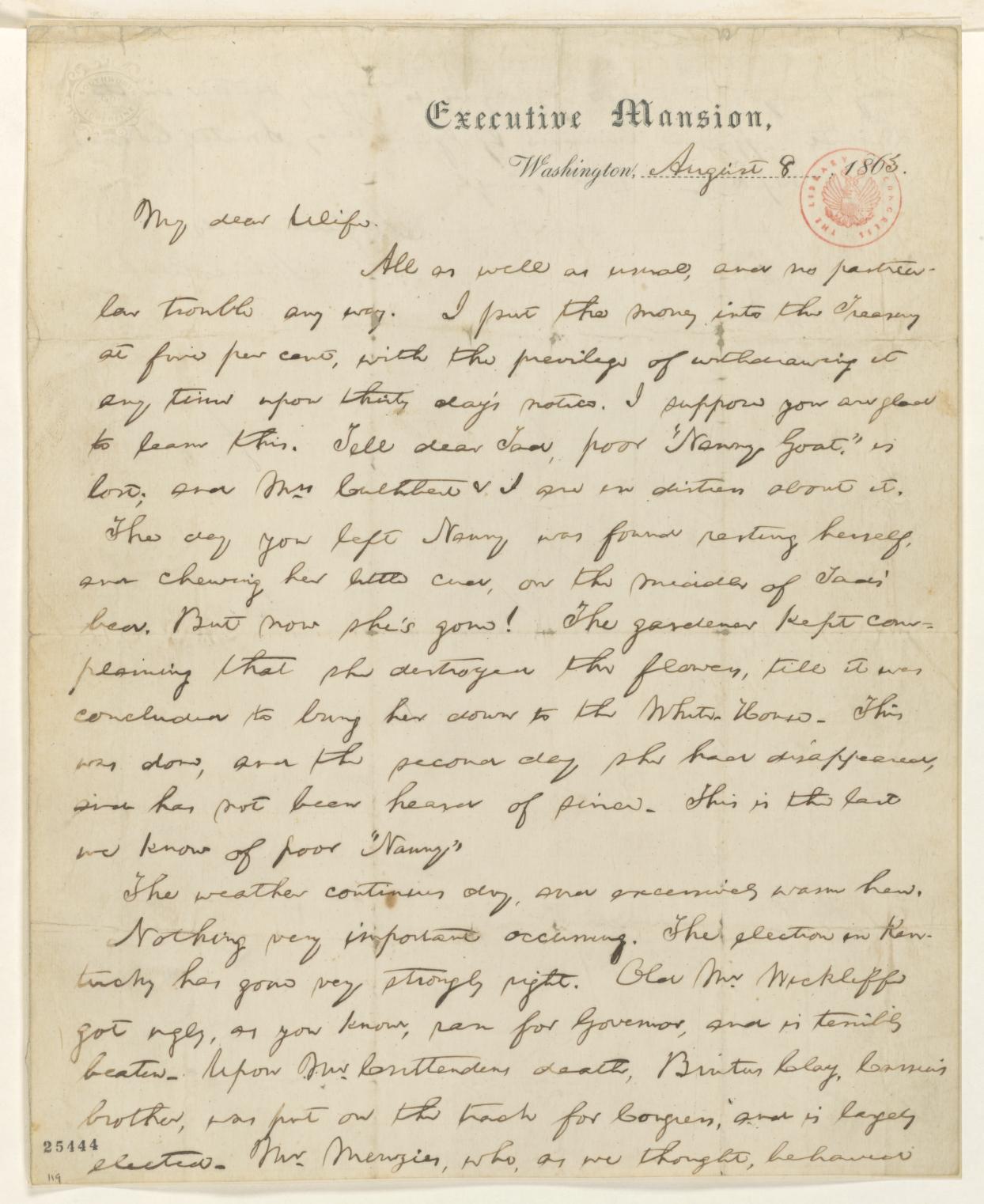
Read the date as August 8, 1863 and the greeting as “My dear Wife.” Compare the shape of the capital W in “Washington” and “Wife”; a known word gives you a reference for a less familiar one. The printed heading is context, not a model of the writer’s hand.
The same scan is shown in full in the actual Heirloom reading. Source: Library of Congress.
A single loop can suggest more than one letter. Trace where the pen rises and falls, then compare the same shape in a word you already know. Use this diagram as a prompt to look closely; it is not an alphabet that every writer followed.
Letterforms that can cause misreadings
| Form | What to look for | Example |
|---|---|---|
| Long s (ſ) | Can look like an f with a missing or partial crossbar; often found at the start or middle of a word. | “ſuch”, “Baſſet” → such, Basset |
| Double s | Often written long s + short s, so it can look like “fs”. | “Miſs” → Miss |
| Capital I and J | Frequently identical; decide from the word. | “Jas.” vs “I am” |
| Capital L and S | Both can start with the same large loop. | Check against known names |
| Capital T and F | Can share loops and cross-strokes; compare examples from the same writer. | “Father”, “Tuesday” |
| u and v, n and u | Rounded and pointed tops look alike in fast writing. | Count the strokes |
| Final e | May be a short flick or omitted in a flourish. | “lov” → love |
Shortened names and words
Writers saved ink and paper by shortening common first names and stock phrases, usually keeping the first letters and the last, often raised above the line. These are the ones you will meet most; for a longer list with worked dates, see old letter abbreviations and what they mean.
- Wm.
- William
- Jas.
- James
- Jno.
- John
- Chas.
- Charles
- Thos.
- Thomas
- Geo.
- George
- Saml.
- Samuel
- yr / yrs
- your / yours
- recd
- received
- do.
- ditto, the same as above
- &c
- et cetera
- inst.
- this month (instant)
- ult.
- last month (ultimo)
- prox.
- next month (proximo)
The sample letter closes “Your affectionate brother / Wm. H. Calloway”. “Wm.” is William; “H.” is a middle initial that the letter itself never expands — so a careful modern version writes “William H. Calloway” and leaves the H alone rather than inventing a name.
Faithful: Wm. H. Calloway
Modern: William H. Calloway
Dates and numbers
- Inst., ult., prox. — this month, last month, next month, relative to the letter’s own date.
- Ordinals such as 14th or 3d (third) are often written with raised letters.
- Ones and sevens can look alike; check against other numbers in the same hand.
- Old-style years in very early documents may differ from the modern calendar; check before recording a date between January and March before 1752 in British records.
Use with care
These are tendencies, not rules: writers, regions and decades differ. Treat a confusing shape as a question to settle from the rest of the letter. AI readings make the same kinds of mistakes people do with look-alike letters, so names are always worth a second look.
New to old letters? Start with how to read an old handwritten letter.
Questions
- When did people stop using the long s?
- It largely disappeared from printing around 1800 and from most everyday handwriting over the following decades, though older writers kept it longer. Its presence is a rough clue to a letter’s age, not proof.
- Why are some letters raised above the line?
- Superscript letters mark an abbreviation: the writer kept the first letters and the last one, raised. “Wm” with a raised m is William; “recd” with a raised d is received.
- What does “the 3rd inst.” mean?
- “Inst.” (instant) means this month, so a letter dated in March that mentions “the 3rd inst.” means 3 March. “Ult.” is last month and “prox.” is next month.
- Does this apply to German or French letters?
- No — German letters were often written in Kurrent or Sütterlin, entirely different scripts. See translating old family letters.